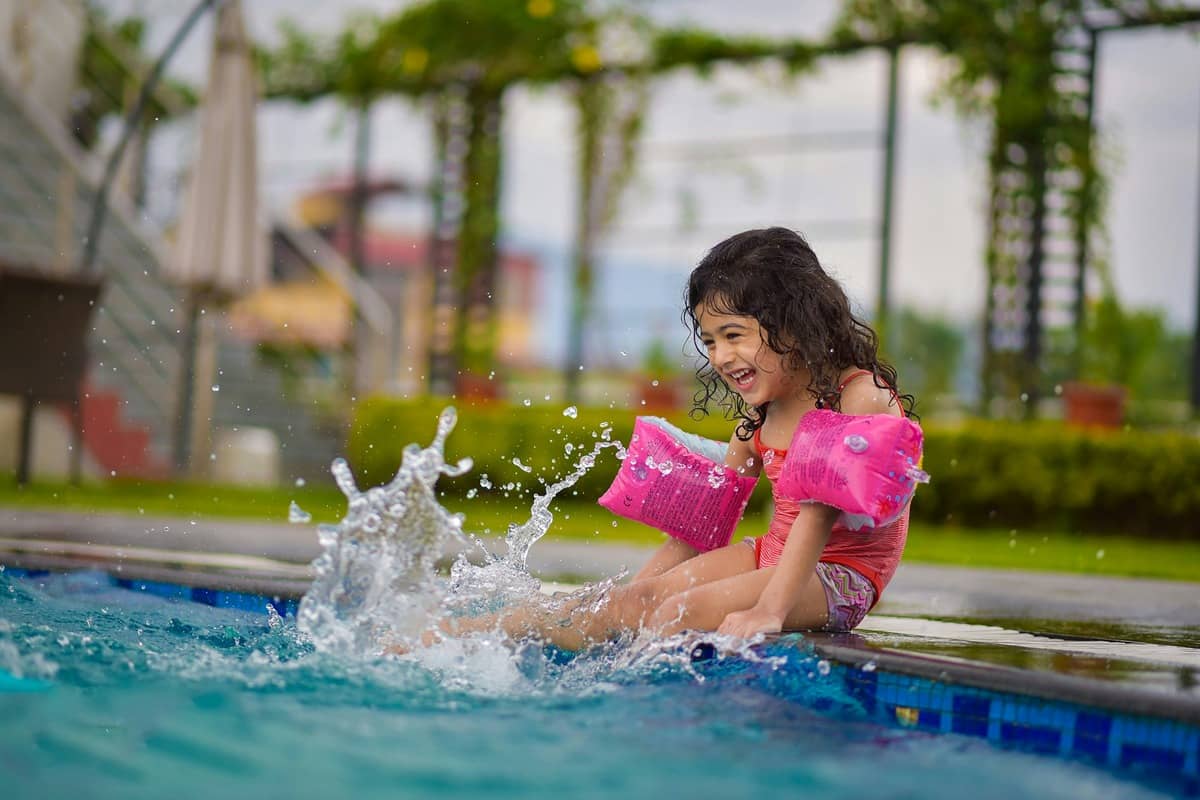
Every parent pictures it a little differently. A birthday pool party they want their child to join without a second thought. A riverbank walk on a warm afternoon. A first family holiday where the sea is part of the fun and not a worry that sits in the back of your mind all week.
Wanting your child to be safe and happy in water is one of the most natural instincts there is. Yet for a surprising number of families in this country, learning to swim quietly slips down the list, squeezed out by cost, by crowded pool timetables, or simply by not knowing where or when to begin. This guide is here to change that. It walks you through why children's swimming matters so much, when a child is ready to start, how to help a nervous little one feel safe, and what genuinely good swimming lessons for children look like.
At Everyone Swims, helping children find their feet in the water is at the very centre of what we do, because we believe water should be for everyone, with no exceptions. So let us start with the honest picture of where children in England and Wales stand today.
Sources: Swim England (Active Lives Children and Young People Survey, attainment and family affluence figures); Royal Life Saving Society UK (Child Drowning Update, September 2024).
- Why children's swimming matters more than ever
- The quiet inequality behind the numbers
- When should my child start swimming lessons?
- How to help a nervous child feel safe in water
- What a good children's class looks like
- Water safety beyond the swimming pool
- Where community swimming comes in
- Parents' questions, answered
Why children's swimming matters more than ever
Swimming is easy to think of as a hobby, something children pick up between football practice and piano lessons. It is far more than that. It is one of the only life skills on the school timetable that can, quite literally, save a life. In England the national curriculum makes swimming a statutory requirement, and every primary school is expected to teach children to swim at least 25 metres, to use a range of strokes, and to perform safe self-rescue if they ever find themselves in difficulty in the water.
The reality falls short of that promise. Swim England's research shows that around 200,000 children, almost a third of every year group, leave primary school without being able to swim that basic 25 metres. Across the wider school population, only about 60 per cent of five to sixteen-year-olds can manage it unaided, which is roughly 368,000 fewer children than could do so before the pandemic. Rising costs and pool closures have made it harder and harder for schools to secure pool time and cover the travel needed to get pupils there, and children are the ones who lose out.
Why does the length of a pool matter so much? Because water does not wait for a child to be ready. The Royal Life Saving Society UK reports that, on average over the last four years, one child a month has drowned at home in England alone, before you even count rivers, canals, lakes and the coast. A child who can float, turn onto their back, keep their airway clear and calmly reach the side is a child far better equipped to survive a moment they never planned for. That is the real reason to prioritise it, long before it becomes a source of holiday fun or lifelong fitness.
The quiet inequality behind the numbers
Look a little closer at who can swim and who cannot, and an uncomfortable pattern appears. A child's ability to swim in this country still depends heavily on how much their family earns. Swim England found that only 39 per cent of children from lower-income families can swim 25 metres unaided, compared with 82 per cent of children from wealthier ones. Put plainly, a child from a well-off household is more than twice as likely to leave school able to swim than a child whose family is stretched.
The same gap shows up by postcode. Fewer than half of children attending school in the most deprived areas, around 47 per cent, can swim the curriculum distance, against 69 per cent in the least deprived areas. Swimming is not always free at the point of use, private lessons add up quickly, and families juggling tight budgets or long working hours often cannot get a child to a poolside every week. None of this is a reflection of how much those parents care. It is a reflection of a system where a life-saving skill has quietly become something you can afford, or cannot.
It is worth adding that the picture differs across the UK. In Wales, swimming is not a compulsory part of the curriculum in the way it is in England, and individual schools decide whether to offer it at all. Wherever you live, the safest assumption a parent can make is a simple one: do not rely on school alone to get your child water-confident. The families who close the gap are usually the ones who treat swimming as a priority to be started early and kept going.
Friendly children's swimming lessons across Cheltenham, Gloucester, the Forest of Dean and Cardiff, built around confidence first.
Book a class in our locations Support the movementWhen should my child start swimming lessons?
This is the question we hear most from parents, and the reassuring answer is that there is no single deadline. Children can begin their relationship with water remarkably early. Gentle parent-and-baby sessions, where a mum or dad holds their little one in warm shallow water, can start from around a year old, and sometimes sooner. These are not really lessons in the formal sense. They are about splashing, giggling, getting used to water on the face, and learning that the pool is a happy place rather than a frightening one.
Formal swimming lessons for children, the kind with a teacher setting real skills, tend to suit most children from around the age of four, when they can follow simple instructions, wait their turn and stay focused for a short session. Guidance from paediatric experts points to a similar window: parent-child water classes from about age one, and readiness for structured lessons by roughly a child's fourth birthday, with the evidence showing that swimming lessons help reduce drowning risk in young children aged one to four. By five or six, most children are ready to start learning proper strokes such as front crawl.
How to help a nervous child feel safe in water
Some children run straight for the water and never look back. Others cling to your leg at the very edge, and that is completely normal. A wary child is not a problem to be solved so much as a small person who needs a little more time and a lot of reassurance. The good news is that the things that help are simple, and most of them cost nothing.
Start with familiarity long before the first lesson. Bath time is a brilliant, low-pressure rehearsal: pouring water gently over shoulders, blowing bubbles in the bath, letting your child tip their head back with your hand supporting them. Talk about swimming warmly and often, so the pool becomes something to look forward to rather than a mystery. On the day itself, arrive early enough to sit at the poolside together, watch other children having fun, and let the noise and echo become ordinary rather than overwhelming.
Above all, let the pace be your child's. Never force a frightened child under the water or into the deep end to hurry things along; it almost always backfires and can plant a fear that lasts for years. Instead, celebrate the small steps out loud, one toe in, one splash on the face, one float held for a few seconds, because to a nervous child every one of those is a genuine act of courage. Keep sessions positive and stop while it is still fun. Confidence built gently tends to stick, and a child who trusts the water is a child who will keep coming back to it.
What a good children's swimming class looks like
Not all swimming lessons for children are cut from the same cloth, and knowing what to look for helps you choose well. The best children's classes are small, so every child is seen and no one is left drifting at the back. They happen in water shallow enough for children to stand, with a qualified teacher who stays close, speaks in a warm and encouraging way, and treats a nervous child's worries as completely reasonable rather than something to push past.
You should see structure without pressure. Good teachers build skills in a sensible order, from blowing bubbles and getting the face wet, to floating, to gliding, to the first proper strokes, and they let each child move up when they are ready rather than on a fixed timetable. Games and play are not a distraction from learning; for young children they are how the learning happens. And a class that welcomes parents to watch, at least at first, gives an anxious child the anchor of a familiar face and gives you the reassurance of seeing exactly how your child is getting on.
Water safety beyond the swimming pool
Lessons in a warm, controlled pool are the foundation, but the water children meet in real life is rarely so predictable. Rivers run faster and colder than they look, the sea has currents and shifting depths, and even a garden paddling pool or a bath can be a hazard for the very youngest. Swimming lessons are one important layer of protection, not the whole of it, and the layers work best together.
A few habits make a real difference. Teach children the simple idea of floating on their back to rest and stay calm if they ever fall in unexpectedly, because fighting the water tires a body out fast while floating buys precious time. Talk to them about cold water, which can steal the breath in seconds even from strong swimmers. Keep young children within arm's reach around any water, and make sure they know that jumping in to rescue a friend or a pet is exactly what they should not do; calling for help and reaching out from the side is far safer. These conversations, repeated calmly over the years, are as much a part of learning to swim as anything that happens in a lesson.
Where community swimming comes in
Look back at that gap between children who can swim and children who cannot, and it becomes clear that the problem is rarely about willingness. It is about access: whether there is an affordable pool nearby, whether lessons fit around a working family's week, and whether the cost sits within reach. This is precisely the space that community swimming exists to fill, and it is why Everyone Swims was founded.
We are a not-for-profit Community Interest Company, which means we have no shareholders and no profit tucked away in the price of a lesson. Every penny goes back into one goal: getting a million people into water, and reaching first the children and families the pool has too often left behind. Subsidised access is built into how we work from the start, so that a child's chance to become a confident, safe swimmer is not decided by their family's income.
Parents' questions, answered
Give your child the confidence and safety that come from learning to swim, at a pace that suits them. Come exactly as you are, and we will take the first steps together.
Book a class in our locations Make a donationTeach a child to swim, and you give them something no one can ever take away. Let us make sure it is a gift every child can share.